Wednesday, February 22, 2012

10 Best Collaboration / Innovation Tools on the Web


Tim Ferriss provides these excellent examples of creative use of the web to support innovation and collaboration.
1. X PRIZE Foundation (www.xprize.org): The X PRIZE focuses on designing and running incentive competitions in the $1M – $30M arena focused on solving grand challenges.
2. CoFundos (cofundos.org): cheap and really good platform for the development of open-source software.
3. Genius Rocket (geniusrocket.com): solid crowdsourced creative design agency composed solely of vetted video production professionals producing content as a fraction of the cost of a traditional ad agency.
4. Amazon Mechanical Turk (mturk.com): popular and powerful crowdsourcing platform for simple tasks that computers cannot perform(yet), such as podcasts transcribing or text editing. There are also companies, like CrowdFlower, that leverage Mechanical Turk (and similar tools) for even more elegant solutions.
5. Innocentive (www.innocentive.com): one of today’s best online platform for open innovation, crowdsourcing and innovation contests. This is where organizations access the world’s brightest problem solvers.
6. UTest (http://www.utest.com): the world’s largest marketplace for software testing services.
7. IdeaConnection (www.ideaconnection.com): open innovation challenge site for new inventions, innovations and products.
8. NineSigma (www.ninesigma.com): open innovation service provider, connecting clients with a global innovation network of experts.
9. Ennovent (www.ennovent.com): worldwide expert platform seeking solutions for sustainable development in energy, food, water, health and education in rural India.
10. TopCoder (www.topcoder.com): the world’s largest competitive software development & creative design community, with over 200,000 at your fingertips.

Thursday, February 9, 2012

How Do You Think About the Future...try MindTime Maps

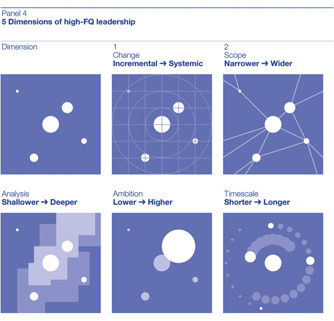
In the daily grind to execute strategies through project-based work, it may seem like the future is too far to matter, especially when innovation is the goal..  A recent study, Future Quotient, provides insights and frameworks that help leaders think how the world will be different in the future, whether for you employees, your customers, your partners.
Future Quotient, co-authored by Volans and JWT, introduces the Future Quotient (FQ), which is designed to measure our ability to think and act along inter-generational timescales.
The report also included use of a really nifty and innovative technology from my friend, John Furey, CEO of  MindTime Technologies.  Their technology enables you and your team to create powerful MindTime maps. These are designed to help groups and organizations develop a greater awareness of how thinking about time is shaping and driving people’s roles, decisions, attitudes, and much more.
A simple 2-minute quiz locates people in the world of thinking™. Everybody learns how their thinking is driving their perceptions, communication, and relationships. When you create a MindTime map of your group or organization, you can expand your insights into how thinking is shaping it all by choosing from a menu of pre-prepared surveys on a variety of topics (brand allegiance, innovation, leadership, happiness, etc). These are offered to participants at the time they map their own thinking and results are shown as correlations between thinking archetypes and participant’s responses. See how you and your time rate in thinking about the future at MindTime Maps

Tuesday, January 17, 2012

The Secrets to Successful Strategy Execution: The Idea in Practice - Ilona Steffen, Niko Canner, and Gary Neilson - Harvard Business Review

The Secrets to Successful Strategy Execution: The Idea in Practice - Ilona Steffen, Niko Canner, and Gary Neilson - Harvard Business Review

There are several critical lessons from this company's experience in the Idea in Practice. Here is a preview:

Find a common language. Make sure everyone can talk about the execution issues you face in the same way.

Walk the talk. People at the top of the organization need to believe in the changes and visibly support them so that the rest of the organization is motivated to change behavior.

Focus on both organizational and behavioral changes. It is more effective to change both rather than focusing on one or another.

Know your organization. There is no one-size-fits-all approach to improving an organization's ability to execute. You must find what works for you.

Sunday, January 15, 2012

Taking People With You By David Novak: Great Read and Most Useful - Bob Sutton

Taking People With You By David Novak: Great Read and Most Useful - Bob Sutton

Innovation Requires Great Projects

Innovation of any type requires the successful execution of project-based work. A recent MIT Sloan Management Review article (What Great Projects Have in Common by Dov Dvir and Aaron J. Shenhar) captured the essence of successful projects based on research across different industries. These seven reinforce what practical experience has shown as critical for success in a rapidly evolving business environment.

As part of a decade of research, Dvir and Shenhar collected quantitative and qualitative data on more than 400 projects that were undertaken in various industries since the late 1950s. ... They searched for projects with unusual success and long-term impact and found that seven managerial characteristics were common.  A great project:
  • Creates a unique competitive advantage and/or an exceptional value for its stakeholders.
  • Begins with a long period of project definition dedicated to defining a powerful vision and clear need and selecting the best execution approach.
  • Creates a revolutionary project culture. The execution of great projects often requires a different project culture, which can later spread to an entire organization.
  • Needs a highly qualified project leader who is unconditionally supported by top management.
  • Maximizes the use of existing knowledge, often in cooperation with outside organizations.
  • Has integrated development teams with fast problem-solving capability and the ability to adapt to business, market and technology changes.
  • Has a strong sense of partnership and pride.

Friday, January 13, 2012

Culture is Key to Succesful Innovation

Booz & Company has an excellent set of accessible PDFs on culture and innovation.  Culture is a critical element of our Stanford Advanced Project Management program (seats still available for delivery on campus at Stanford in March) and these results reinforce its importance for innovative strategy execution.

...Booz's annual Global Innovation 1000 study looked at two particular qualities — strategic alignment and a culture that supports innovation — that truly innovative companies have put in place that allow them to outperform the competition.
Every company among the Innovation 1000 follows one of three innovation strategies — need seeker, market reader, or technology driver. While no one or another of these strategies offers superior results, companies within each strategic category perform at very different levels. And, no matter a firm's innovation strategy — culture is key to innovation success, and its impact on performance is measurable. Specifically, the 44 percent of companies who reported that their innovation strategies are clearly aligned with their business goals —and that their cultures strongly support those innovation goals — delivered 33 percent higher enterprise value growth and 17 percent higher profit growth on five-year measures than those lacking such tight alignment.
... In a comparison of the firms voted the 10 most innovative versus the top 10 global R&D spenders, Booz & Company found that the most innovative firms outperformed the top 10 R&D spenders across three key financial metrics over a 5-year period — revenue growth, EBITDA as a percentage of revenue and market cap growth.

Tuesday, January 10, 2012

Changing Meetings At Google

Buisness Insider  brings some insights from Google CEO Larry Page on running meetings.

  • Every meeting must have one clear decision maker. If there's no decision maker -- or no decision to be made -- the meeting shouldn't happen.
  • No more than 10 people should attend.
  • Every person should give input, otherwise they shouldn't be there.
  • No decision should ever wait for a meeting. If a meeting absolutely has to happen before a decision should be made, then the meeting should be scheduled immediately.