Showing posts with label Culture. Show all posts

Wednesday, August 1, 2012

5 things that happen when you really know your strategy

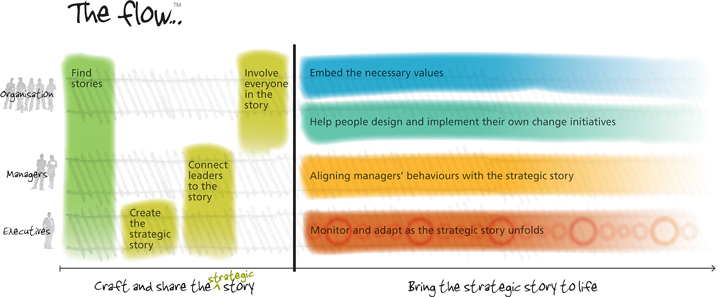
Wow---what a succinct way to know you (and those you lead "get your strategy").  This post is from an interesting group Anectdote in Australia, focused on the power of storytelling in organizations. Wonderful diagram of their work is below.  Worth a look and they offer a very useful newsletter!

Here are five things that happen when you really do know your strategy:
  1. you know when to say 'no.'
  2. you get better support from your colleagues--they are trying to achieve the same things
  3. you can wing it with confidence--the strategy is your safety net
  4. you can focus on doing the right things rather than just doing things right
  5. you can act with more autonomy because you know where others are going, and autonomy is motivating


Saturday, March 26, 2011

Leading Change from the Middle

Yesterday we completed the Spring session of our on-campus Stanford Advanced Project Management (SAPM) program with students from all over the world, Global Fortune 100 firms, and innovative non-profits. (Note--apply or register for the SAPM Summer session June 12-17 here.)  I had the privilege of working with Tim Wasserman, IPS Learning CLO, Shirzad Charmine of Coaches Training Institute, and Dr. Behnam Tabrizi, author of Rapid Transformation: A 90-Day Plan for Fast and Effective Change, in delivering Leading Change from the Middle. The book and Behnam's research served as one of the anchors for the course.
We had a fantastic, energetic, enthusiastic class with folks from around the world.  The class comraderie added to the vivid discussions we had around a variety of case studies as well as guest lecturer from HP.  One student, an Aussie working in Switzerland, even had her young baby and husband with her.
Some ideas and concepts from the course discussions include:
  • Change yourself first, than help others
  • Fast is better...always.
  • Be willing to change...transformation requires agility and adaptability.
  • Though working from the middle, top executive support is required.
  • Purpose matters--principles first...then methodology.
  • 90 days is not long, work fast, work smart


Saturday, March 19, 2011

Failure is an option...fear is not! ...James Cameron

Nothing else ever. Ever tried. Ever failed. No matter. Try again. Fail again. Fail better. 
Thank you Samuel Beckett.  Failures of all types are in the news and several fascinating perspectives on the power of failure...if you view it as an outcome and learn from it follow.

1-Director James Cameron  at TED
The director of the two highest grossing films in history--Avatar and Titanic-- ends this great TED Talk with "Failure is an option, fear is not."  He notes that failure has to be an option to innovate.  Watch it and learn!

This issue provides a wonderful array of articles and learnings around failure.  The introduction sums up the issue:
Failure. We’re hypocrites about it. Go online, and you’ll find scores of pleasant aphorisms celebrating the inevitability of failure and the importance of learning from it. But in real life—and in real companies—failure is anathema. We’re afraid of it. We avoid it. We penalize it.
It’s time for managers to get past platitudes and confront the F-word taboo. In this special issue every article provides some home truths about good failures (when we expect to fail and learn something), bad failures (when we’re sabotaged by errors in judgment), or unavoidable failures (when complex systems break down). Failure is inevitable and often out of our control. But we can choose to understand it, to learn from it, and to recover from it.
3-Learning from IDEO
In our Stanford program, we use many examples from IDEO, the Palo Alto, CA, US, design consultancy. Tim Brown, IDEO CEO,  reminds us of the power of learning from doing (a la fast prototyping) in this post from his excellent Design Thinking blog: .
...it is important it is to remind ourselves of the value of experimentation. My hypothesis is that organizations generally avoid experimentation when it comes to processes and management. In fact they positively hate it. One reason may be that it is scary to mess with people and processes and much harder to do than messing around with new technology or new products. That feels more like an excuse than a reason to me. I believe we lack processes for prototyping our ideas quickly when it comes to management. ...experiments too often turn into initiatives. Experiments are designed for learning and it is okay if they fail whereas initiatives are too important to fail. I came away thinking that initiatives are things to be avoided at least until you have learnt from some experiments.


Friday, March 18, 2011

Power of Organizational Culture

In our Stanford Advanced Project Management (SAPM) program we focus on the significance of culture in executing strategy through project-based work.  Jon Katzenbach has studied organizational culture throughout his career and leads The Katzenbach Center at Booz & Company. They have an excellent presentation with downloadable PDF on evolving organizational culture. Some key learnings from them include:
  • culture correlates with business performance
  • culture, strategy, and operating model must be in sync (see the IPS Strategic Execution Framework (SEF) Model)
  • existing culture can be a powerful source of energy
  • change behaviors, not mindsets
  • focus a few key behaviors
  • don't change culture if you don't need to
  • use both rational and emotional forces for reinforcing new behavior patterns
  • use formal and informal approaches

Friday, October 8, 2010

Vision Statement: Why Mumbai at 1 PM Is the Center of the Business World - Harvard Business Review


Vision Statement: Why Mumbai at 1 PM Is the Center of the Business World - Harvard Business Review.

Super article for anyone managing globally distributed teams--looks at time zone and global holidays to find times for best meetings.

Friday, March 19, 2010

Culture Matters – compare Apple and Microsoft Design Guides for Phone Apps

Microsoft Immediately Stumbles in Quest for Well-Designed Phone Apps | Design & Innovation | Fast Company.

Culture and its impact on how an organization can best execute its strategy are a key element of our Stanford SAPM program. This article provides fascinating insights on how culture(How we do things here) affects design.
The newly released app-design guide reveals a lot more about Microsoft than they probably intended.