Super article for anyone managing globally distributed teams--looks at time zone and global holidays to find times for best meetings.

His columns inspire a spirited and educational set of responses join in and share your perspectives.
- If your organization's performance (operating income) = 100%, roughly what percentage is accounted for by the quality of the organization's strategy (clients we target; products, services and results we offer; the way we organize and compensate people, etc.) vs. the quality of the organization's execution of its strategy (the quality of our people, work, processes, decisions, etc.)?
- If your organization's strategy = 100%, roughly what proportion of its effectiveness is dependent upon and accounted for by the organization's culture (widely-shared values, beliefs, behaviors, rites and rituals, etc.)?
- If the execution of your organization's strategy = 100%, roughly what proportion of its effectiveness is dependent upon and accounted for by the organization's culture?
 We have recently completed working with a wide variety of large global firms on designing & planning unique complex global programs. Though each is uniquely different, there are patterns and threads that are the same. These ten questions provide a quick way of assessing how well such programs are being designed , planned, and managed:
Few things in the airline business are more daunting than upgrading to a new reservations system. Do it well and customers are none the wiser; mess it up and a carrier risks losing customers and tarnishing its brand.
Discount carriers JetBlue Airways Corp. and WestJet Airlines Ltd. both switched reservations systems in the past few months. The differing outcomes are a reminder of how the implementation of new technology can be just as crucial as the technology itself.
Despite months of planning, when WestJet flipped the switch on its new system its Web site crashed repeatedly and its call center was overwhelmed. It took months to resolve all the issues. JetBlue, which later upgraded to the same software, smoothed its transition by building a backup Web site and hiring 500 temporary call-center workers....
Make sure the right people are involved
Assign homework
- Ensure diversity.
- Invite contributions based on expertise, not rank..
Create the right atmosphere
- Make sure predecision due diligence is based on accurate, sufficient, and independent facts and on appropriate analytical techniques.
- Request alternatives and “out of the box” plans—for instance, by soliciting input from outsiders to the decision-making process.
Manage the debate
- As the final decision maker, ask others to speak up (starting with the most junior person); show you can change your mind based on their input; strive to create a “peerlike” atmosphere.
- Encourage admissions of individual experiences and interests that create possible biases.
Follow up
- Before you get going, make sure everyone knows the meeting’s purpose (making a decision) and the criteria you will be using to make that decision.
- Take the pulse of the room: ask participants to write down their initial positions, use voting devices, or ask participants for their “balance sheets” of pros and cons.
- Commit yourself to the decision. Debate should stop when the decision is made. Connect individually with initial dissenters and make sure implementation plans address their concerns to the extent possible.
Monitor pre–agreed upon criteria and milestones to correct your course or move on to backup plans.
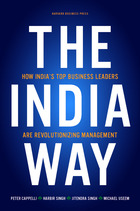
The India Way How India’s Top Business Leaders are Revolutionizing Management By Peter Cappelli, Harbir Singh, Jitendra Singh and Michael Useem
Today's Financial Times has useful review of this.
... innovative management practice from India's leading companies and what companies everywhere can learn from it. For much of the last century, the practice of management was dominated by Western, particularly U.S., models. Even economies emerging in the latter part of the century evolved toward the Western paradigm. But today, we see a distinct model of management developing in India and, so far, it has been remarkably successful. India's top companies are growing at staggering rates and doing so with an innovative and vibrant set of management practices - especially in strategy, leadership, governance, talent and organizational culture. Not bound to Western thinking or practice, Indian leaders are creating a new model for leading and running companies.