Friday, September 21, 2012

First Ever Strategic Execution Conference--Join Us!


IPS Learning and the Stanford Center for Professional Development will jointly present “The Strategic Execution Conference: Linking Strategy to Execution through Innovative Techniques” April 24 and 25 at the Hyatt Regency San Francisco Airport, 1333 Bayshore Dr., Burlingame, CA. Ram Charan, highly acclaimed business advisor and author, will keynote the opening conference session. 
The two-day conference will bring together more than 1,000 executives, leaders and senior managers from major high-tech and innovative organizations worldwide to gain insight on current and future challenges surrounding strategic execution from the world’s preeminent thought leaders. Details at www.executionconference.com. 

Thursday, September 6, 2012

Scaling Large Projects and Programs

Stanford Professors, Bob Sutton and Huggy Rao, teach in our Stanford Advanced Project Management Program, and are completing research and a book on scaling-up excellence. In a recent post, Bob pointed to Ben Horowitz's thoughts on "Taking the Mystery out of Scaling a Company". Working with leaders of complex project-based work or PBW (programs and projects) in a variety of global companies, I have seen the challenges of scaling from a small, co-located program team to a globally-distributed team with hundreds of employees and myriad vendors and contractors. Horowitz suggests three scaling techniques:

  • Specialization: you can not do everything and know everything as you grow
  • Organizational design: communications architecture for your PBW but recognize there is no perfect one
  • Process: purpose of process is communication
Helping firms scale large PBW, I find Horowitz's critical steps around organizational design for scaling (my comments are in italics) to be especially insightful:

  1. Determine what needs to be communicated (Who needs to know what, why, and what is the smoothest way to provide it? We are talking not just technical but also management information; engineers with minimal leadership experience often overlook the importance of non-technical information.)
  2. Identify decisions that have to be made (Start that decision log, however small and own it. Be crystal clear about how your PBW leadership team needs to make decisions. De facto approaches cause problems...fast. Decide by design not default.)
  3. Prioritize the most important communication and decision paths (Especially critical for globally-distributed teams in multiple cultures and time zones. Focus on what makes it easiest to get the program's work actually done.)
  4. Decide who runs which groups (no multiple owners of work--one, single person is responsible for each group)
  5. Identify communication paths that you did not optimize and mitigate (You cannot give all paths the same weight; recognize which ones that have less attention and plan for addressing those issues that may surface.)

Horowitz's post is worth a serious read for application to designing and leading PBW.  

Wednesday, August 1, 2012

Olympics 2012--great resource for learning how it was done

The London 2012 Olympic Development Authority has created a very useful web site on what they have learned in designing and building the facilities.  Even if you are not in construction, there is much of interest here for any of us that lead large, complex projects!
Through the Learning Legacy project, the Olympic Delivery Authority is sharing the knowledge and the lessons learned from the construction of the Olympic Park, to help raise the bar within the sector and act as a showcase for UK plc.

5 things that happen when you really know your strategy

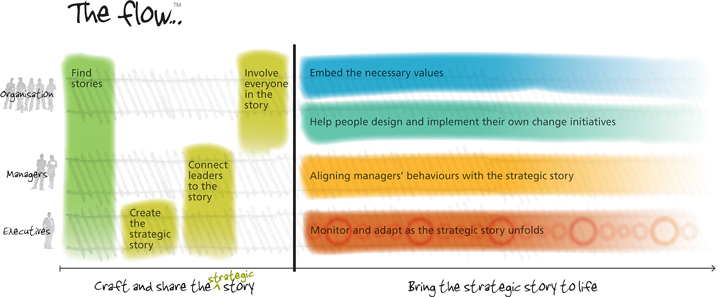
Wow---what a succinct way to know you (and those you lead "get your strategy").  This post is from an interesting group Anectdote in Australia, focused on the power of storytelling in organizations. Wonderful diagram of their work is below.  Worth a look and they offer a very useful newsletter!

Here are five things that happen when you really do know your strategy:
  1. you know when to say 'no.'
  2. you get better support from your colleagues--they are trying to achieve the same things
  3. you can wing it with confidence--the strategy is your safety net
  4. you can focus on doing the right things rather than just doing things right
  5. you can act with more autonomy because you know where others are going, and autonomy is motivating


Friday, July 20, 2012

Wonderful graphic @ organizational culture

In our Stanford Advanced Project Management program we are always addressing the power of culture in executing strategy through project-based work.  This is a neat diagram from Agilitrix that succinctly captures the critical aspects of the Schneider Model. Their site provides other discussions about the model.


Tuesday, June 26, 2012

Making Culture Change Stick

From the latest Harvard Business Review, Booz & Co.provides a free PDF here.  Worth the read and reinforces the many ways we look at the power of culture in our Stanford Advanced Project Management (SAPM) program.  Our next class coming in September at Stanford University in Palo Alto.  Register here.


Harvard Business Review: Cultural Change That Sticks
by Jon Katzenbach, Ilona Steffen, and Caroline Kronley
When properly harnessed, an organization's culture can be a true differentiator that no competitor can duplicate. However, as pressures on companies build, leaders often become frustrated with the comparatively slow pace of culture evolution. In the rush to implement new strategies and make performance improvements, the legacy culture—employees' ingrained ways of doing things—can seem like the greatest barrier to change. Unfortunately, most well-intended efforts to "change the culture" fizzle out, fail, or backfire.
Here's the good news: There is an alternative.
Drawing on recent research and real examples, the article's authors present a new approach that leverages what is strongest in an organization's existing culture, providing a practical road map for real, substantive evolution in employees' ways of behaving by focusing on a few critical shifts. This approach has been tested and proven in client engagements across a range of regions and industries.
 read more

Wednesday, May 16, 2012

Keeping Gen X Talent Engaged

Don't Dismiss Your Gen X Talent - Sylvia Ann Hewlett - Harvard Business Review

  • Develop corporate chameleons. "Once I've learned my job, I like to move on," says one X'er interviewed for the CTI report. "I need something new to keep things fresh." To prevent X'ers from feeling stalled and browning out, companies are rotating promising employees through different functions on a regular schedule. A Sibson Consulting survey (PDF) shows that more than half of Fortune 500 companies say they've begun shuffling potential leaders around to give them broad experience.
  • Let them learn. "I really like my company. It's a great fit," says another X'er. "But having said that, if it's the right thing, I'd jump. I won't stop learning or growing just to have a job." That's why even in the middle of a recession, smart companies are maintaining their tuition-reimbursement programs, as well as instituting mentoring and sponsorship programs that pair Boomer managers with Gen X'ers.
  • Bring them out of the shadows. Mentoring and sponsorship programs serve another purpose: They match mid-level managers with senior-level executives who can provide opportunities to enrich their career experience. Placing Xers in charge of high-visibility projects is also a way to spotlight their abilities.
  • Test their wings. Many X'ers would agree with one of their cohort who declares, "I have an entrepreneurial spirit that won't shut up." With many having been brought up as latchkey kids, Gen X is highly self-reliant; today, 70% of X'ers surveyed by CTI prefer to work independently, and 34% aspire to be an entrepreneur. Why not let them test their wings with a company-sponsored venture than risk having them fly the coop?
  • Promote partnerships. It's easy for X'ers to demonize Boomer managers as intransigent dinosaurs and Gen Y subordinates as self-aggrandizing upstarts. Break down the barriers through intergenerational partnerships and teams. Each cohort has its own strengths and gifts; sharing them will enhance everyone's abiliti